
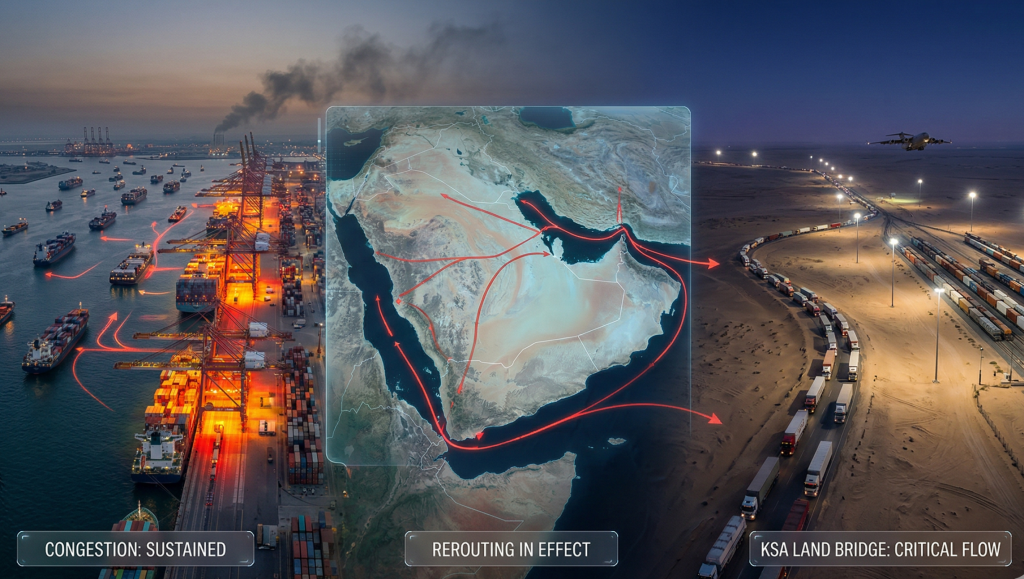
As another week concludes, the operational landscape in Middle Eastern logistics remains heavily constrained. The shift away from the Strait of Hormuz and Bab el-Mandeb has become a significant feature of the current market environment, and shippers and cargo owners must continue to prioritize agility. At RIF, we are closely monitoring these compounding bottlenecks and executing strategic rerouting to help keep supply chains moving.
Here is our end-of-week assessment of the regional infrastructure and actionable steps to help protect your cargo flows.
Multi-Modal Market Status: Ongoing Pressures
The ripple effects of oceanic detours are continuing to place pressure on alternative transport modes across the region:
Air Freight (Severe Constraints): Dubai hubs (DXB/DWC) remain under pressure, with backlogs still affecting operations. Sharjah is operating near capacity. Airlines are implementing reduced schedules and occasional last-minute changes, contributing to elevated airfreight rates. Doha cargo remains restricted.
Ocean Freight (Systemic Congestion): Congestion at Jebel Ali continues to build, and Khor Fakkan is also experiencing elevated vessel delays. With standard transit still disrupted on some lanes, rerouting via the Cape of Good Hope remains a common option for affected services. Doha imports remain constrained, which is contributing to storage and delay costs for diverted containers.
Road Freight (Intense Modal Shift): As cargo shifts from air and sea, regional road networks are under substantial pressure. We are tracking tight truck capacity across the Oman, Fujairah, and Saudi corridors. High-risk routes, such as the Kuwait-Iraq corridor, are experiencing delays and enhanced inspections.
Holiday Impacts on Clearance
Compounding the physical congestion is the impact of reduced holiday staffing. Operations across customs authorities, port terminals, and banking institutions may be slower than usual. Shippers should build in expectations for 24 to 72-hour delays on standard clearance and border crossings.
RIF’s Strategic Guidance: How to Adapt
With no clear short-term recovery signals, proactive management remains essential. Saudi Arabia continues to emerge as one of the most stable logistics hubs for regional rerouting.
To help mitigate risk, RIF advises the following immediate actions:
-
Reroute proactively: Plan alternative air routings via Abu Dhabi (AUH) or direct into Saudi Arabia where appropriate to help avoid DXB and Doha bottlenecks.
-
Pre-verify documentation: Driver restrictions remain tight in some lanes, particularly for Qatar. Ensure all documentation is pre-verified and submitted early to reduce the impact of holiday staffing delays.
-
Budget for escalation: Factor in rising costs across the board, including base freight, fuel, insurance, and emergency surcharges.
-
Shift communication protocols: Standard automated tracking systems may be less reliable during rapid rerouting. Rely on direct contact with your RIF representative for the most current cargo milestones.
Need to adjust your current routing? The market is changing daily. Contact the RIF Team to review your pending shipments and help secure alternative capacity where required.